
The most useful first AI project is usually a small piece of work you already understand. It should have a clear input, a checkable output and a person who can decide whether the result is good enough. This guide shows how to choose that task and run a focused pilot.
1. List the work you repeat
For a few working days, note the tasks you repeat: preparing an internal update, organising notes, drafting a standard explanation or turning approved material into a brief. Record the time spent and the common points of confusion. Include checking and corrections, not only the first draft.
Do not start by choosing the most impressive tool. Start by finding a task whose current process is clear enough to describe in a few sentences.
2. Screen the candidates
A suitable first task is frequent enough to matter, has accessible source material and allows a person to check the result before it affects anyone else. Avoid beginning with decisions that are difficult to reverse or require specialist judgement you cannot verify.
| Question | A useful answer |
|---|---|
| What starts the task? | A known input, such as approved weekly notes. |
| What should the output contain? | A short, explicit checklist of required information. |
| Who checks it? | A named person with the knowledge to identify errors. |
| Can we reverse the trial? | The manual process remains available. |
3. Set a baseline
Choose a representative sample and record how the task is currently completed. Note preparation time, execution time, review time and corrections. Use the same definition of “finished” for the current process and the AI-assisted version.
For example, “draft created” and “approved update ready to share” are different endpoints. Measuring only generation time can hide extra editing work.
4. Run a small pilot
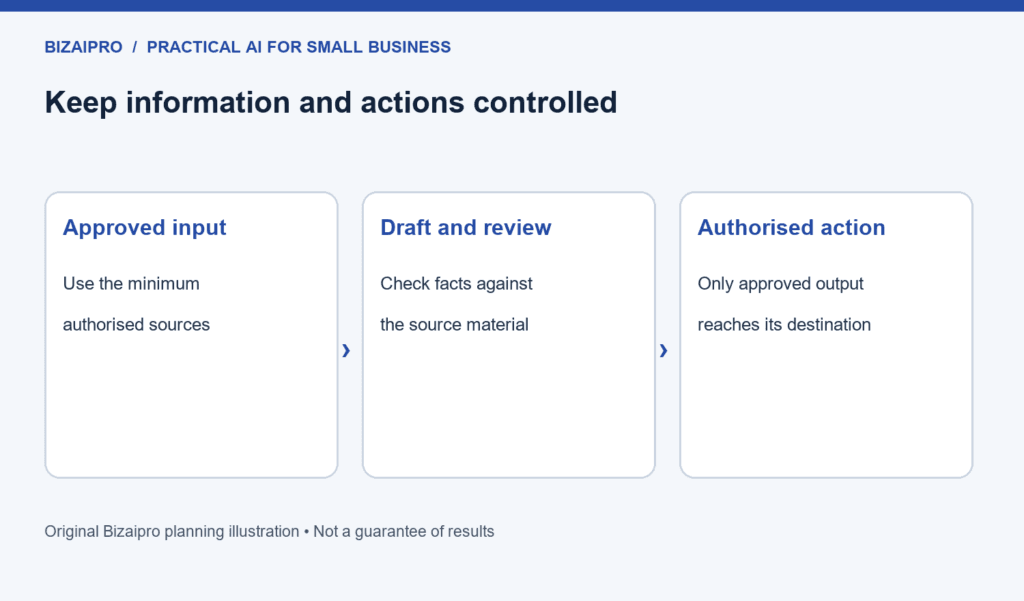
Use approved, anonymised or fictional information. Give the tool the purpose, audience, source material, constraints and desired format. Ask it to list missing information instead of filling gaps with guesses.
Try ordinary inputs and at least one incomplete or awkward example. Record failures and repeat attempts consistently. If you keep changing instructions, save each version so you can tell what improved the result.
5. Make a decision using total effort
Compare the approved outputs, total time and errors. Include software cost and the effort required to maintain the process. A faster draft may still be a poor fit if reviewing it is difficult.
Write a decision in plain language: continue because the result meets the agreed standard; revise because a specific issue remains; or stop because the expected benefit did not appear. Define when to review the workflow again.
Your pilot record
- Task, owner and intended outcome.
- Approved inputs and acceptance criteria.
- Current time and quality baseline.
- Tool, plan, instructions and trial date.
- Total effort, errors and limitations.
- Decision, next action and review date.
Next, use our comparison worksheet to evaluate alternatives or the AI ROI calculator to explore your own cost assumptions. A small pilot is evidence about that task; it is not proof of performance across your business.